next regular meetings will be:
Next meeting 28th August 19:30 by zoom
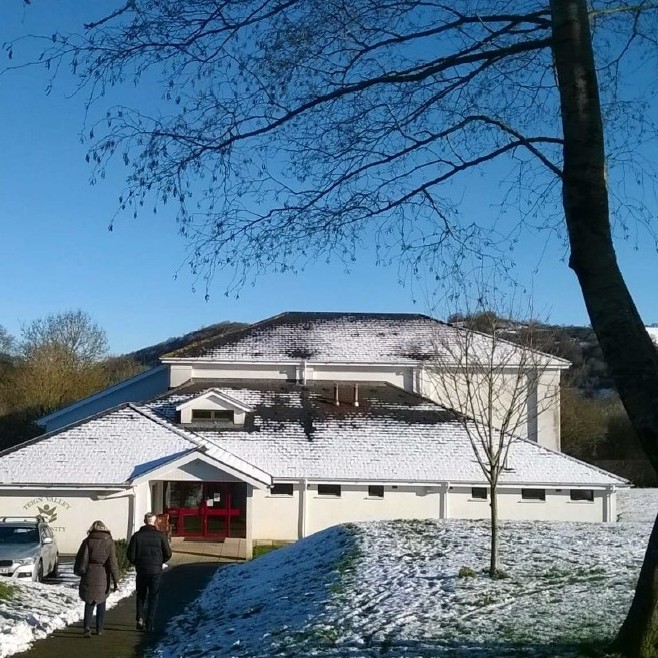
Here is what we covered when we met at the Teign Valley Community Hall:
- Carbon and energy reduction at the Teign Valley Community Hall
- Biofuel Watch
- Energy related planning policies, guidelines and strategies
- Learning about Climate Change, how to communicate for effective action
- More on grid battery charging, response from 3 industry experts & pumped hydro
- It was interesting to hear the background and process leading up to the major refurbishment of the TVCH’s heating and acoustics. You can read a summary of this in one of our case studies here, go to chapter 5.1 on page 14. This lead to some interesting discussions, including whether it was worth it. Specifically, the carbon and financial pay-back as well as the price of a tonne of avoided carbon.
The numbers clearly show a significant 13.38t CO2e avoided each year, an impressive success. A saving of £2,623 per year at net present value is more modest, especially given the relatively high cost of the project. It was, however, pointed out that the improved comfort, the initial reason for the refurbishments, is not measured in financial pay-back, just like it isn’t when we buy a more comfortable mattress! As a comparison, the UK government’s central estimate for the value of CO2e in policy appraisal last year is £256 per tonne (based on 2020 prices over 30 years). - Biofuelwatch say they “provides systemic analysis based on secondary and occasionally primary research and undertakes advocacy and campaigning in relation to the climate, environmental, human rights and public health impacts of large-scale industrial bioenergy.” In essence they are not in favour of any biomass use for energy generation, especially the most damaging like Drax.
We have covered this topic a few times in the past, especially the question of whether burning biomass is carbon-neutral. Their FAQs make it clear the believe the answer is NO because “It can take years for that same amount of CO2 [when burnt] to be locked into biomass by a plant [sequestered]”. They then assert that “Biomass also emits more greenhouse gases per unit of energy than most fossil fuels.”, a dubious claim based on the false premise that CO2 released from burning cannot be sequestered, the point they want to prove, a classic circular justification.
Unsurprisingly, coal has about four times the calorific value of wood. Typically, and assuming sustainable wood supply, one cubic meter ~950kg of coal contains ~7,500 kWh of energy and would emit ~3,200 kg CO2e. To generate the same energy you’d need ~4.35t of wood logs emmiting ~177 kg of CO2e. These are consumption based emissions, so include mining/harvesting, processing and transport. Even the lowest Carbon Intensity fossil fuel, natural gas, would emit ~1,600 kg CO2e for the same energy, more than 10 times that of wood! See the CFT to lookup consumption emissions from wood products, a 90% efficient biomass boiler will generate 1.1-1.8 MWh of heat energy per cubic meter of logs, depending on wood type and quality.
The point they seem to miss is; sequestering CO2 over ~150 years cannot be compared to ~150 million years of sequistration to make fossil fuels. While it is possible, and essential, to sequester emissions from burning biomas through sustainable agriculture, the same is not possible for fossil fuels.
To their credit, the following FAQ covers the IPCC’s statement on carbon neutrality of biomass. Unfortunately, it appears they either did not read or not understand this. The key point in Q2-10 of the IPCC reference they quote is that emissions from biomass burning should be calculated as part of land use emissions rather than emissions from burning the biofuel. A sustainably managed biomass crop (say 10 year rotation or more) would have a net-zero impact. The consumption carbon emissions in the CFT (used in the example above) covers processing and transport emissions as published by the UK government.
If you are interested, we cover this question as part of the Carbon Cutting and Carbon Lite training sessions. - TheDevon County Council have published a revised landscape policy document for renewables. A number of district councils and Community Energy groups, provided input to this. It is not clear to what extent this input was taken on board, for example the CPRE’s ‘tranquil’ and ‘dark skys’ map from 2006 and 2016 are still being used as criteria for effective exclusion.
The RTPI’s guidance in relation to local energy infrastructure planning was recently published. This provides further spatial planning guidence to councils.
Teignbridge District Council is consulting on the major modifications made by the examiner of the local plan 2020-40. Consultation ends 1st Oct 2025. Let me know if you have any comments you’d like to make with respect to renewables and ghg emission targets.
These policies and the local plan are likely to be impacted by the publication of the government’s onshore wind strategy. - A recording of he Plymouth Uni training I mentioned at our last meeting can be found here. I have a meeting scheduled for the 3rd August to discuss how best to communicate Climate Change in terms of its causes, concepts and effective actions. We’ll be comparing notes on our respective training programs.
Some of ACT’s Carbon Cutters are planning to train as Climate Ambassadors under the Dept. for Education’s STEM Learning programme. Let me know if you are interested. - Many in the industry are still unaware or unwilling to admit that electricity grid Carbon Intensity (CI) is not always linked to Time of Day (ToD) tariffs. As we discussed previously (notes from 10.04.25 meeting). Our region has a particularly high CI during cheap off-peak rates. In a recent webinar hosted by Vest Energy, an energy trading and optimisation company, this question was raised in respect of their Community Battery proposition. Its was encouraging to hear back from 3 members of the panel acknowledging this point.
I’d forgotten to mention the interesting visit to high-density pumped-hydro trial operated by Rhenergise and organised by Regen. One surprising target is the over 80% round trip efficiency at the grid expected from this system, get more information on this grid-scale storage system here.
Leave a Reply