The next regular meeting will be on Thursday 26th October 2023 at 19:30 – 21:00 (and every 4 weeks thereafter). Note start time will alternate between 16:30 and 19:30 . See the personal e-mail sent for the zoom link code to use or contact ACT.
Here are some of the topics raised and discussed.
Energy group meetings, timing change and venue:
In order to allow others who may find 16:30 a difficult time to join the regular group meetings, we will be running these alternatively starting at 19:30 and 16:30. Our next meeting will start at 7.30pm.
If you would like to offer your place (home or office) as a venue for a face-to-face meeting, please let me know. You are not expected to prepare any material about your place, just offer it for people to meet. Please let me know what dates you can offer and what the maximum number of people are invited.
Recent government announcements on Climate Change mitigation:
We had a good, wide-ranging discussion about the reasoning and impact of the retrospective policy changes the government has announced in the past few months. Ignoring the hype and point scoring inevitably associated with such significant changes in policy, it seems clear that mitigating Climate Change has dropped several notches down the government’s priority order. While some of the arguments put to justify these policy changes could have some merit, there are almost no new policies to rebalance the quite dramatic shift away from reducing our ghg emissions.
We also discussed the potential economic damage and mistrust created by the messaging alone. Inevitably this will slow an already snail-pace progress to reduce emissions, but many may simply ignore the government’s stance and continue to decarbonise as they can see the tide has already turned. Maybe we are witnessing another nail being driven into the coffin of party politics? Especially when it comes to strategic/long-term policies that affect everyone. Are we moving ever closer to evidence being determined by those standing on the highest soap box, like the most recent assertion on ecological damage from wind turbines?
Residential Batteries:
This topic came up again as group members continue to be approached by enticing offers. It is difficult for many of us not to be drawn by plausible ‘evidence’ of financial and climate benefits presented by those selling these systems.
We reviewed the guide provided on the ACT website (Energy group page) to see if this could be made clearer or more accessible. A number of improvements were suggested, including navigating to the various guides at the top of the web-page using pictures/icons. We’ll review changes made at the next meeting.
Maybe we should cover this topic in a few case studies and visit examples of installations. I had a quick look at a well-designed residential battery system records, installed in 2017. To date, this showed an avoidance of ~9,500 kWh imported grid electricity, equivalent ~£2,000 of savings and ~2,700 kg CO2e avoided emissions, less the financial and emissions cost of installing the system. Financially in the red, but already significantly up on emission reduction. Pretty much confirming the advice and calculations suggested in the guide.
Are sea-levels rising?:
Or should this be “Is sea-level rising” since water levels out?!
Unsurprisingly, we tend to believe what we experience firsthand. Unfortunately, this may not always be what is actually happening, magic tricks are a good example. Then there are all these cognitive biases we need to overcome to make sure that what we are experiencing is reflected in what everyone else sees everywhere else.
Let’s take the actual and predicted sea level rise caused by a warming world. I don’t think anyone disputes that ice melts when heated. It’s easy to believe that the relatively small areas of ice compared to ocean on the earth’s surface cannot possibly increase sea-levels by very much, certainly not the meters some talk about. Without knowing the volumes and surface area, it would be unwise to make an assertion either way.
Most of us are aware of how tides vary, even just around the UK coast. Not only seasonally, but also with the cycles of the moon, the air pressure, water temperature, water salinity, ocean currents and river flows. Then there is the coastal topography which affects tides as well as the much slower changes in the relative hight of land masses compared to abutting sea-levels.
Is it therefore wise to measure local tides in one place over a period and conclude that globally sea level rise caused by Climate Change is not as bad as it is made out to be? We discussed how sometimes, well founded observations can be misleading if we do not consider all the evidence. It’s not always easy because we may not be aware of critical information, so discussing this with others to calibrate our conclusions is essential. We will never know if we’ve stumbled on something no one has spotted, unless we allow everyone to present their case to encourage open dialogue.
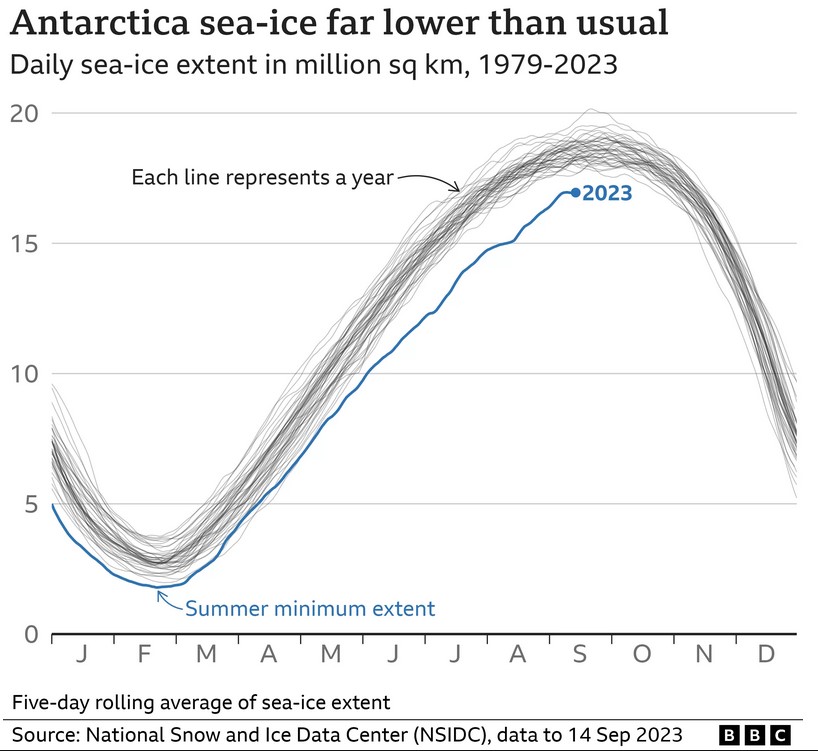
There was a little-publicised report on the Antarctic ice shelf in 2023, possibly one of a number of tipping points predicted by the IPCC modelling. Here are some references on this topic:
- How/what NASA measure on global sea-levels
- UK parliament publication from 2010
- Latest Antarctic ice shelf extent
- DEFRA’s detailed report on sea level rise
Loft insulation dilemma and AAHP:
We tried to reassure Rob that the balance he was striking between more loft insulation vs. loss of long-term storage space, was ‘ok’. These are personal decisions, ideally made on the available evidence/calculation to come to an ‘informed’ decision.
We also briefly touched on Air-to-Air Heat Pumps. The use and specification of these is less regulated, but they can be appropriate in specific settings. As with most technologies, it is important to design the system to fit the requirements.
Consultation on car parks in Newton Abbot:
Jules and I represented ACT at the district council’s initial stakeholder event on car park use in Newton Abbot. I’d sent out this invite to those who registered their location as Newton Abbot and ticked the ACT Transport group.
Our impression is that the usage/occupancy data collected was useful but did have some significant gaps in reflecting actual usage. We made a number of recommendations which will hopefully be reflected in the report from this first of several consultation event. One thing most participants agreed on is that the town centre multi-story is heavily under-utilised (also reflected by the data collected). Also that the multi-story car park was not inviting to users and generally an eyesore.
Best wishes
Fuad
Coordinator for the ACT Energy group
covering energy, built environment and transport
Leave a Reply