The UK government has committed to a big expansion of carbon capture and storage (CCS), along with plans for more oil and gas drilling in the North Sea. Using CCS is a prerequisite of expanding fossil fuel extraction if the UK is to stick to its target of reaching net zero by 2050.
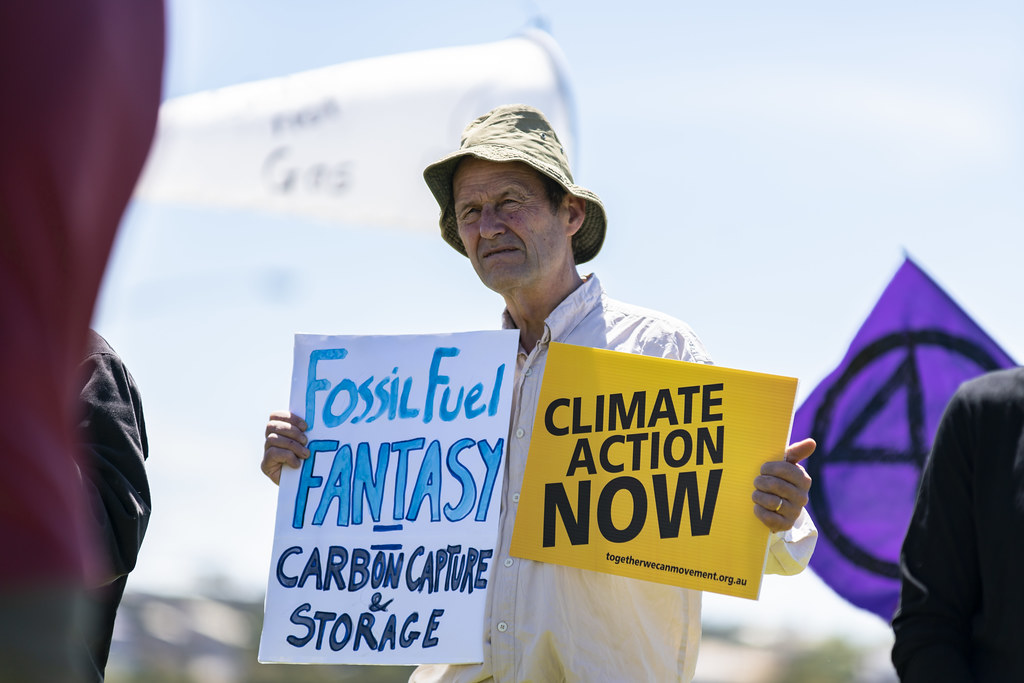
The government will spend £20bn over 20 years to support the establishment of two CCS clusters by 2025, and a further two by 2030. The aim is to capture 20-30 megatons (Mt) of carbon dioxide (CO2) a year and store it under the North Sea.
Scientists think this is a bad idea. The Guardian newspaper reported that more than 700 scientists wrote to the prime minister before the announcement asking him not to grant any new oil and gas licences and describing CCS as “yet to be proved at scale”.
CCS involves capturing the CO2 produced by power generation or industrial activity, such as steel or cement making; transporting it; and then storing it deep underground. The technology has been around since the 1970s, but has been used mainly to boost oil production. There is no evidence it can be used at scale to permanently store CO2. There are questions about the expense involved, the storage capacity, the potential for leakage, and the effectiveness of the process.
A 2021 report by the Centre for International Environment Law found that the 28 CCS facilities currently operating globally have a capacity to capture only 0.1% of fossil fuel emissions, or 37Mt of CO2 annually. Of that capacity, just one-fifth, or 7Mt, is being captured and stored for the long term. This suggests the UK plan to capture 20-30Mt a year is over ambitious, to say the least.
More recently, New Scientist covered a report by the Institute for Energy Economics and Financial Analysis (IEEFA), an Australian think tank, which found most of 13 flagship CCS schemes worldwide either failed or captured much less CO2 than expected. Two Norwegian projects were more successful, which the report said was due to the country’s business and regulatory environment.
There is a strong suspicion that investing in CCS is just a means for the fossil fuel industry to carry on “business as usual”, with little attempt being made to reduce carbon emissions. See this video for a satirical take on this.
Climate scientist Kevin Anderson said on Twitter: “The promise (though virtually no delivery) of CCS for almost 2 decades has been repeatedly used to undermine the shift away from fossil fuels. It has been a deliberate & effective delay strategy.”
As if in confirmation, the chief executive of US oil group Occidental Petroleum said earlier this year that DACS (Direct Air Capture & Storage) “is going to be the technology that helps to preserve our industry” and gives it “a licence to continue to operate for 60, 70, 80 years”.
For more on carbon capture and storage, in its various forms, see these notes.
Leave a Reply