The next regular meetings will be:
Thus. 31.07.25 at 16:30 in-person looking at a site of interest.
Then 28th August by zoom at 19:00
Here is what we covered:
- Meeting, purpose, format and times
- Global energy use and latest Carbon Budget, where are we?
- Devon and Teignbridge Climate plans, are they delivering?
- EV popularity, is it waning and why?
- New EPC standard (RdSAP 10), are they useful?
- Cooperation and competition in humans, which edges it?
- Government rooftop PV drive and balcony PV systems.
- Recent webinar/training: understanding climate change and secondary suppliers.
- We discussed the purpose and style of the meetings. One possible reason given for the low participation was confusion around the different times meetings were held (alternatively 19:00 and 16:30). Other reasons were that the notes were sufficient for most people. Please let me know your thoughts on the matter and any suggestions to improve participation or if you think it’s ok as it is.
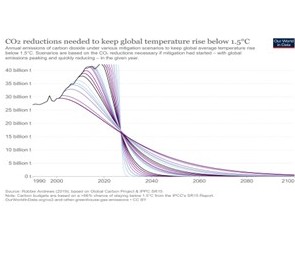
We decided to give the in-person meetings a practical focus, so the next one will hopefully be to help a group member find his mystery zombie-load and demonstrate how they’ve gone about reducing their building’s energy consumption. - The International Energy Agency Global Energy Review 2025 is worth a read. It reports some encouraging trends, but GHG emissions are still going up. This means we’re using up our Carbon Budget even faster, requiring a more dramatic reduction in emissions as seen by the featured chart.
If you’d like to understand what this essential graphic means to the actions we have to take, why not register for one of our Carbon Cutter Lite sessions? Or come to a meeting and ask. - You can read progress on the Devon Carbon Emergency plan here. For Teignbridge as a whole, TDC has been compiling its own Carbon Plan covering the same themes (areas to tackle). TDC officers have compiled a number of actions for them as well as district councillors and local councils in the district to undertake. ACT has worked with TDC to make the objectives meaningful and implementable. The draft plan will now go for formal approval by the council in the autumn. We very much hope the key actions/initiatives agreed will remain and be acted on. ACT is committed to help deliver these to achieve the necessary GHG reductions in the district.
If anyone is interested in being involved in some of the proposed initiatives, please contact me. - EVs have become more controversial in recent times. Like all new things, there is much misinformation and scepticism, the introduction of steam (from coal) powered trains is a good example from the past. While there are several impartial/balanced sources for information (e.g. TECs’ Electric Vehicles guide), there are probably more sources of mis/dubious information. It is however surprising to see this from a reputable source quoting an attitude survey by the AAA (American automobile association).
Admittedly this is the US which we felt differed from the UK (49% of those considering a new car would get an ultra-low emissions vehicle according to this attitude survey, and this summary of statistics). US consumers appear not to be as aware of their contributions to climate change compared to Europeans. It’s all about the money and convenience, clearly they’ve not played the E=mC2 game! - The methodology to measure a building’s energy performance (EPC) has been updated and it is better. You can find out about the details in this webinar recording, the first part is a good introduction explaining the impact on anyone selling/renting or considering home improvements. Anyone interested in learning more about how to make building more energy efficient can contact me, look at our energy webpage or consider attending a building physics course like the AECB’s.
- The question of how did China leapfrog the US with its cheaper and more efficient AI approach was raised by a member. This is generally attributed to a number of reasons, including the greater cooperation in open-sourced software. It’s also helped by the Chinese government’s significant investment in technology, especially AI and, ironically, the restrictions placed by the US forcing China to innovate even faster.
A good discussion in which we agreed that healthy competition was necessary, but competition for the benefit of financial/personal (or national) gain over others alone was ultimately self-defeating. With so many challenges facing humankind, it is sad to see conflict and division are still elevated by some for personal gain. - The government has published its Solar roadmap in which it encourages the deployment of PV, especially behind the meter. As well as the roadmap, the link references so called “balcony” PV systems and attitude surveys for the UK.
A group member asked if these balcony PV systems were worth having. As always, the answer depends on the purpose. These systems are generally cheaper as there is no labour involved, but also smaller as space and orientation are more limited. So the cost per installed kWp or generated kWh/year are no better than the payback you get from a conventional rooftop system. Because the bundled inverter plugs into a 13A socket, the maximum power generated will be limited (~0.8 kWp). See TECs’ solar PV guide for more information on how to select a PV system that meets your objectives. - Plymouth university are running general and targeted workshops on Net-Zero and climate change. The general (introductory course) covers the same scientific material on the cause and consequences as ACT’s Carbon Cutter and CC Lite sessions. It is less clear on the actions people/organisations can take although it does include a forward-looking “Carbon Handprint” approach to actions. I’m hoping to have a meeting to exchange views and explore collaboration.
Energy System Catapult ran a webinar exploring secondary electricity supplier models. That is buying your electricity from more than one supplier. Typically, this is envisaged for specific usage such as an EV charger. This was another significant study on how financial benefits could be extracted from time-of-use (ToU) tariffs without mentioning the need to line up ToU tariffs with local/regional Carbon Intensity (CI) of the grid. Luckly this question was acknowledged right at the end of the Q&A session. Indeed, the same Living Labs team had previously published a study that shows the ‘herd mentality’ created by targeted ToU tariffs. This creates an even higher peak demand than the current evening peak, defeating the primary reason for such tariffs. More worryingly, it results in higher overall GHG emissions, the exact opposite of why such studies are being undertaken. It would make more sense to spend the same effort exploring how to link ToU tariffs to low-CI so this can be financially beneficial to suppliers and consumers.
See item #2 from our 24th March 2025 meeting for details on how to use grid CI.
Written by Fuad
Energy group coordinator
Leave a Reply