- Leaking flat roofs, too cold and too hot.
- Centre for Sustainable Energy’s study of variable tariffs.
- Spain’s power outage.
- Wind and solar farms.
Unless anyone would like to suggest another venue in Teignbridge, the next in-person meeting will be at the Taphouse in Newton Abbot.
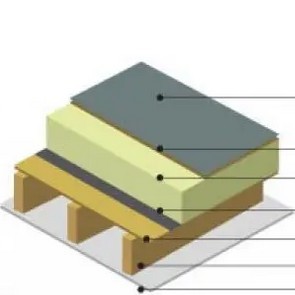
- Flat roofs are notorious for leaking, but they can also be a problem to insulate. If you live under a flat roof with inadequate insulation, you are likely to lose heat in winter and overheat in summer. So what’s the solution?
Unfortunately retrofitting insulation in a flat roof isn’t as easy as adding traditional loft insulation between and above ceiling joists in the loft space of pitched roofs (also referred to as a cold roof insulation because the loft space remains cold). Flat roofs typically do not have easily accessible space between ceiling and roofing material (often the finish is roofing felt). So to gain access, either the ceiling or the roof covering have to be removed to add insulation.
If there is a leak and the felt or outer roofing material has to be repaired/replaced, this is an opportunity to add insulation. Ideally above the rafters or a combination of this and between rafters. Insulation above rafters is sometimes referred to as ‘cold roof’ insulation, but the term is misleading when applied to flat roofs. Here is a useful explanation.
There are also better roofing materials than felt, but these tend to be more expensive and require skilled installation, something the UK building trade is not famed for!
Drawing curtains to keep the sunshine out in summer and in winter to keep the warm air in helps a lot. Opening windows if there is a marked temperature difference between inside an outside temperatures, this can cool/warm the room as needed. - The CSE provides very good research and advice to achieve its mission. The recent webinar was billed to cover “The transition to a smart, low-carbon future” and how it “is transforming how consumers interact with the energy system”. You can watch it here.
Two ACT energy group members had attended. It was strange that the webinar did not mention carbon emissions at all, focusing instead on financial benefits from these tariffs. You can watch the study’s conclusions, which are not surprising given that these ‘smart’ tariffs are aimed at those who want/can engage in how/when they use their electricity.
As we’ve discussed on several occasions in the past, including last month’s meeting, There is a big mismatch between low-carbon claims associated with low-tariffs. The question was raised and answered by the CSE team at the end of the webinar if you want to take a look. Let’s hope they check out the information we gave them in the Q&A and include this information in future. - Several sources were quick to blame the major electricity grid outage in Spain, parts of France and Portugal on renewables. While it is true that most of Spain’s daytime generation at the time was renewables, this is not an unusual situation. It is not yet clear what triggered the cascading shutdown, related to frequency fluctuations which cause automatic shutdown of all generator types. No doubt not enough contingency planning had been made to prevent major and multiple failures from taking down the whole electricity grid. Here is a good summary from a week ago.
- We discussed the recent news that the largest offshore wind farm developer is pulling out. This is the second large wind farm development to run into trouble because of escalating costs, in turn caused by the multiple international events in recent years. Read the company’s statement on this here and the broader picture here. The first of these is back on track, so presumably the government will either have to adjust the Contract for Difference (CfD) arrangements or find another developer.
This led us onto discussing onshore wind and solar farms and the relative merits/problems with each. ACT has published its position on this as part of our submission to the Local Plan. In this we favour wind development over solar farms, mainly because of the significant land-efficiency of the former.
Written by Fuad
Energy group coordinator
Leave a Reply