Here are notes from our discussion/surgery on Thus.
Are the elections energising you? Who’s promising what?
As a CIC we stayed clear of any party political discussions, but we did look at some of their policies and actions, specifically in relation to the climate and energy policies. ACT covers two constituencies, candidates for Central Devon and Newton Abbot, both with an incumbent MP from the Conservative Party.
Although not all the manifestos have been published (due soon), we discussed their likely content in terms of policies on the Climate and Ecology. You can also get a summary of where the main parties stand on these:
Compare this with the 2019 manifesto promises on Climate action;
And read where Britons stood on climate policies 6 month ago from the Kings College London piece.
As an adjunct to this discussion, ACT has submitted question to BBC for inclusion in a radio4 programme on the subject of the 2nd court ruling re inadequacy of government policies
“Members of the public may however wonder how effective such rulings can be in holding governments to their commitments to achieve climate change targets. Can they go back on their commitments with impunity?”
What to make of all these industrial innovations?
We regularly cover promising innovations submitted by energy group members. An ammonia engine was referenced at our last meeting, in response green ammonia was sent in as a counter balance. There are many other technologies we’ve covered, low-carbon road building using low-carbon concrete was another, here is the latest ‘breakthrough’ on this.
All of these will help to reduce energy demand and hopefully decarbonise.
Still the most important action which no one wants to talk about is behavioural change to cut out waste.
I also still regularly come across people who are not aware that simple appliances, like some fridge/freezers, can consume nearly 1.5kWh per day. In this case it represented ~40% of total electricity consumption. It was replaced with a larger, 10 year old, second hand F/F which consumes ~0.4 kWh/day.
Responsible travel advice.
In a very good article on this broad subject a group member sent in, I spotted the “be climate smart” advice and a reference comparing ghg emissions from different holidays. The main message was that the length of stay has a significant impact on ghg emissions because of the different emissions from three sources; transport, food and accommodation. This is typically sound advice, stay longer if your travel emissions are high.
I thought I’d better check some of the numbers against ACT’s CFT, here is what I found (all emissions are by weight of CO2e emissions):
e.g. London-North Devon (~450 mi round trip by car @ 50mpg): reference= 37 kg ; CFT= 109 kg
e.g. London-North Devon (~350 mi round trip by train and ~100 by car @ 50mpg): reference= 20 kg ; CFT= 49 kg
e.g. Eating out in France (per person-day @ £30 average diet assuming same as UK): reference= 11 kg ; CFT= 15 kg
e.g. Overnight stay in North Devon (per person-night @ £50): reference= 3.9 kg ; CFT= 27.5 kg
Some are in the right ballpark, but private transport and accommodation seem quite at odds. I trust the CFT more! There are of course other factors that’ll come into play for different people travelling at different times of year, so worth a quick check.
Heating water, what is the best way?
Although this question was in relation to a public building, the approach is almost the same for a private dwelling. Adhering to legionella regulations is one important difference.
The answer is of course; it depends!
The most significant things to find out are how much water is needed at what temperature and when/how often. This gives us the energy requirements and patterns of usage. Then comes the question of what heating system is being used and what are the energy demands/patterns on this. You need to have some idea of the total primary energy demand for the building/occupants before deciding on the most appropriate energy source for heating water or how to adapt an existing heating system to supply this.
It can be as detailed (complex) as you want it to be, but some simple guidance can help. The CFT has reference in the help panel to ‘list of actions’. Search or lookup “hot water”, this will give some of these general guidelines.
Post meeting snippet.
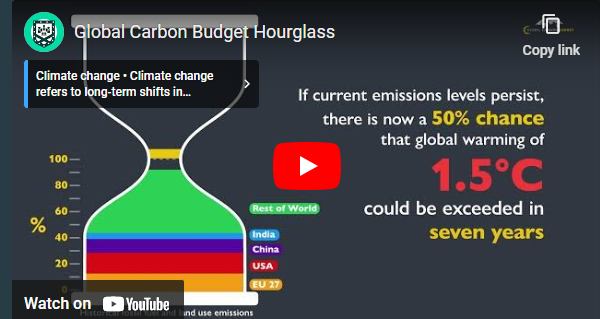
This link came in just after our meeting. It’s a 38 second look at where we are with Climate Change from Exeter University. It is a stark but honest reminder.
Given the catastrophic and irreversible consequences from reaching the tipping point, I’d prefer better odds than 1:2. This is why we should be aiming for odds of 1:3 as agreed in Paris and reaffirmed since by the IPCC, it would leave us with 5.5 years. In practice this means we need to see a dramatic change in the next 6 months.
Russian-Roulette odds at 1:6 are better!
Written by Fuad
Energy group coordinator


Leave a Reply